
Review: Can Herbsmith July Third Help Reactive Dogs? I Tried It Out
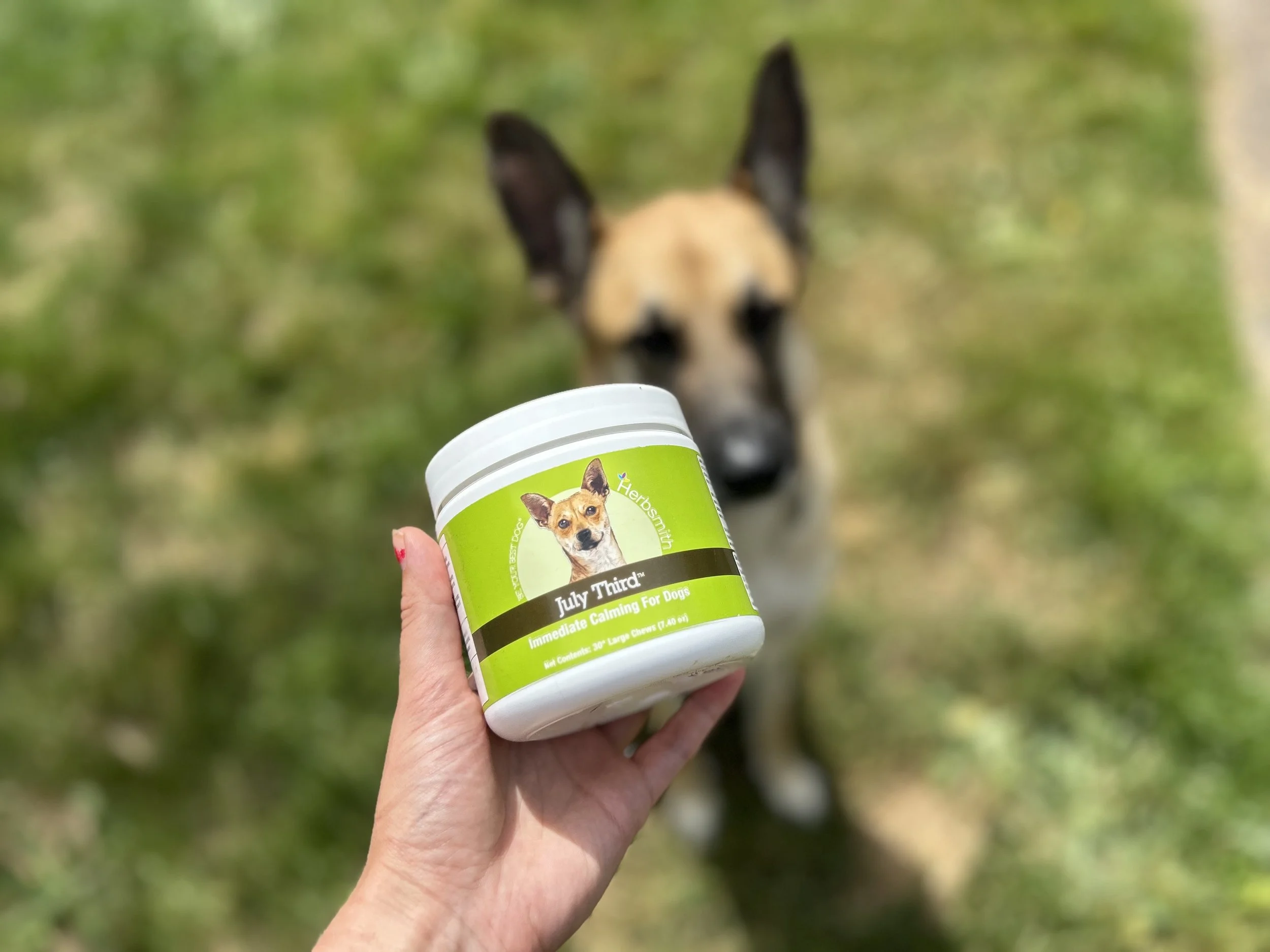
With the 4th of July coming up fast, I figured it’s a good time to post my review of Herbsmith’s July Third calming supplement for dogs. Aptly named after the day before the most stressful day of the year for many dogs (and two days before the highest shelter intake day of the year), these treats are marketed to provide “quick-acting relief for occasional anxiety symptoms.”
Can July Third help reactive dogs, especially for the 4th of July? Yes, in many cases this supplement can bring on relaxation and provide support for a nervous dog. But there are some important factors to consider, and I’ll go over them in this review.
I first bought these treats last summer, the first summer since rescuing a zany German Shepherd mix, after a particularly frustrating day at the beach. I brought him to meet up with a friend by the water, an ostensibly relaxing activity that ended up with constant corrections and redirections as every single person, dog, and sound set him into a fit of excitement and anxiety.
I walked into my local pet store asking how to make my overstimulated dog less of a menace when trying to enjoy summer activities. And the store clerk walked me straight to these calming chews.
July Third calming chews ingredients and breakdown
These calming chews are available for small or large dogs, each with 30 chews per package. I used the treats for large dogs, but the ingredients are the same for both varieties. Here’s what’s inside each container of July Third dog treats:
Rice Flour, Sun Flower Lecithin, Rice Bran, Flax Seed, Oat Groats, Vegetable Glycerin, Salmon Meal, Cod Liver Oil, Fruit Juice, Natural Grain Dextrin, Sorbic Acid, Brewers Yeast, Vegetable Oil.
Here’s the breakdown of calming ingredients per two chews:
Small chews:
42 mg of chamomile
34 mg of tryptophan
28 mg of passion flower
28 mg thiamine monohydrate
22 mg of magnesium
14 mg of valerian
Large chews:
150 mg of chamomile
120 mg of tryptophan
100 mg of passion flower
100 mg thiamine monohydrate
80 mg of magnesium
50 mg of valerian
Now let’s look at each calming ingredient:
Chamomile(Matricaria recutita): An herbal supplement used as a sedative, anti-inflammatory, and muscle relaxant
Tryptophan: An essential amino acid used to build proteins, muscles, and enzymes
Passionflower (passiflora incarnata): A flowering plant commonly used to help with sleep and anxiety
Thiamine mononitrate: A form of Vitamin B1, primarily used as a dietary supplement
Magnesium: An essential mineral and element, magnesium plays a crucial role in hundreds of bodily processes, supporting nerve and muscle function, regulating blood pressure, and more.
Valerian(Valeriana officinalis): A perennial herb native to Europe and Asia, valerian is often used as a natural sleep, anxiety, and stress remedy.
Clearly, these treats are rooted in herbal remedies and essential nutrients. But do they get the job done?
My review of Herbsmith July Third calming supplements
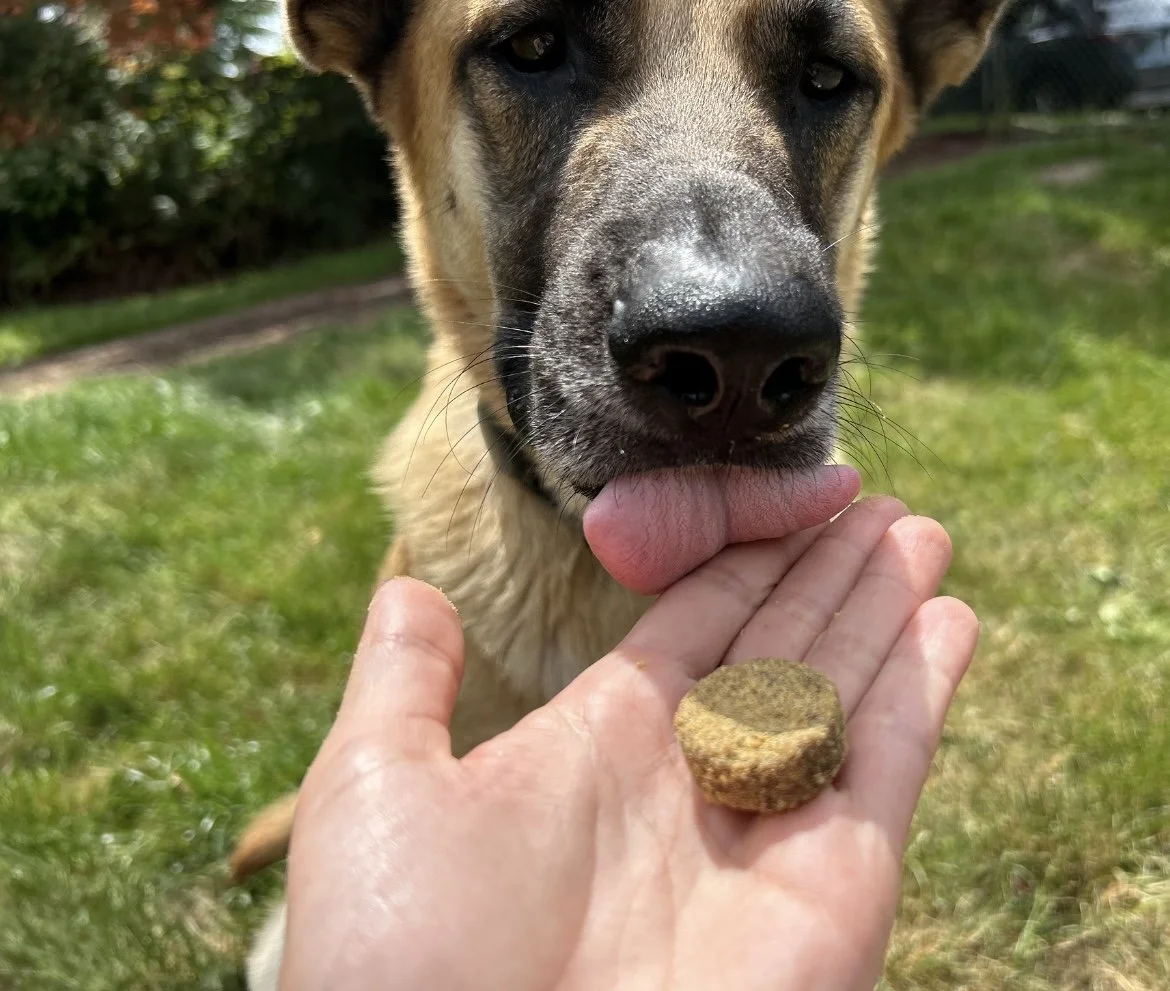
As you read this review, keep in mind I tried the large chews for large dogs. The recommended doses are 2 chews for dogs 30-59 lbs, 3 chews for dogs 60-99 lbs, and 4 chews for dogs over 100 lbs. If you’re using the small chews, the recommended doses are 1 chew for 5-10 lbs, 2 chews for 11-20 lbs, and 3 chews for 21-30 lbs.
The first time I used July Third treats, I went for three chews. My dog weighs about 60 lbs, so he’s on the cusp between 2 and 3 recommended chews. But he’s also a wild ball of energy, so I figured I’d go with the larger dose. Fortunately, he seemed to like the taste and had no trouble gobbling up three (though I made him work for each one).
I noticed he began to chill out about an hour after his dose. The effects were subtle at first. We went back to a beach to test out his reaction to other dogs, people, and sounds that typically overstimulate him. He showed his usual signs of alertness and curiosity, but with a noticeable decrease in intensity. I’d say at this point, about an hour after the dose, his typical excited state had dropped by about 25%.
Within the next half hour or so, he became a lot more dopey. He was not out of it, but he made the conscious decision to lay down in the sand and watch people walk by. That’s not his normal behavior. I was stoked.
Overall, he was a much calmer, much more relaxed dog for the rest of the day. The effects lasted somewhere between 8 and 12 hours and his disposition remained calm but a bit subdued the whole time. He was still alert and able to carry out all commands and activities, but with a noticeable ease.
Since then, I’ve used 2-3 chews here and there for support. If we’re going somewhere I know he gets over-the-top excited about, I’ll consider giving him some of these supplements to set him up for success.
But I will caution owners to not rely on these treats for daily support. I noticed that if I used these treats multiple times in a week, the effects diminish because my dog’s body adapts. That’s why I save them for bigger occasions where I know my dog can use some extra support.
Here’s where I really think these treats can shine:
July Third to desensitize reactive dogs to triggers
There’s a lot that goes into desensitizing a reactive dog to their triggers. From my experience, this supplement can be a useful tool. The anecdote I gave about going to the beach is a prime example: my dog was able to better adjust to the commotion and make more calm, relaxed choices.
I can imagine these supplements helping in situations where reactive dogs just need a little extra support. Let’s say you’re working on their reactivity and want to slowly work closer to a trigger. It’s possible that these treats could help for the first forays closer to major triggers, giving your dog a little more support and sense of calm to make the decision to turn their attention back to you.
Of course, these shouldn’t be the only source of help for training a reactive dog. They may play a role in the process, but there’s a lot that goes into helping a reactive dog succeed–far beyond just taking supplements.
Can July Third treats help for the 4th of July?
As the name suggests, these dog treats can be helpful for 4th of July support for reactive dogs. But from my own experience, I wouldn’t expect them to completely ease all of your dog’s anxiety, especially if they’re super scared of fireworks.
However, they could potentially help you create an overall environment that sets your reactive dog up for success this holiday. These treats, combined with a safe and comfortable environment and all safety measures in place, could potentially ease your dog’s fear during the stressful time.
I think they’re worth a shot, especially if your dog gets nervous and needs a bit of support for loud noises. If your dog is totally incapacitated by the sound of fireworks, I’m not sure they’d be strong enough to provide meaningful support. That’s not to say they can’t, just that from my experience, the effects are somewhat subtle.
July Third vs. Trazodone
When I adopted my dog, the shelter sent us home with a pill bottle full of Trazodone to support him. While we didn’t need it much for his adjustment into the home, I have used it on occasion to support him during anxiety-inducing experiences.
In my experience, Trazodone is much stronger with a more intense sedative effect. My dog rarely uses it, typically only if we have to leave him for a bit at a new hotel or place he’s unfamiliar with. When he takes Trazadone, he typically falls asleep and is a much slower form of himself.
If I had to quantify it, I’d say July Third helps bring my dog’s overstimulation or stress down anywhere from 15-40%, depending on the dose and trigger. Meanwhile, I’d say Trazadone takes it down 50-75%.
However, I don’t use either of these options regularly, which likely prevents him from building up a tolerance.
The final verdict: July Third is effective for my dog, but not strong enough for all uses
I love July Third calming chews and have used them to help support my dog over the last year and a half. The package contains 30 dog treats and I just finished my second one. So that means I’ve used them about 20-30 times over the last 18 months.
That’s enough help for my dog, but for those who need more consistent support, it may be worth exploring other options that meet your budget and behavior goals.
As with all supplements for reactive dogs, it’s a good idea to talk with your vet before making any changes. They will have a better idea of your dog’s situation and can provide tailored advice that suits your needs.
Want to learn more about reactive dog training and support? Check out ourother articles for more information.
Written by: Macey Wolfer
Macey Wolfer is a freelance writer from Seattle. She wants to see more confident dogs and owners with a lower rate of shelter surrenders.
This content is for educational purposes only and is not a substitute for professional veterinary, behavioral, or training advice.